
How to Rent a Mobile Walk-In Freezer in Virginia: Costs, Sizing and What to Ask
Forty-eight hours is a useful number to remember. A full, unopened freezer holds its temperature for about that long once power stops, per USDA food safety guidance. A half-full one manages about 24.
A failed compressor is a different problem. The insulated box may be fine, but the system that cools it is not. Product begins warming as soon as cooling stops, and a repair part can take days to arrive.
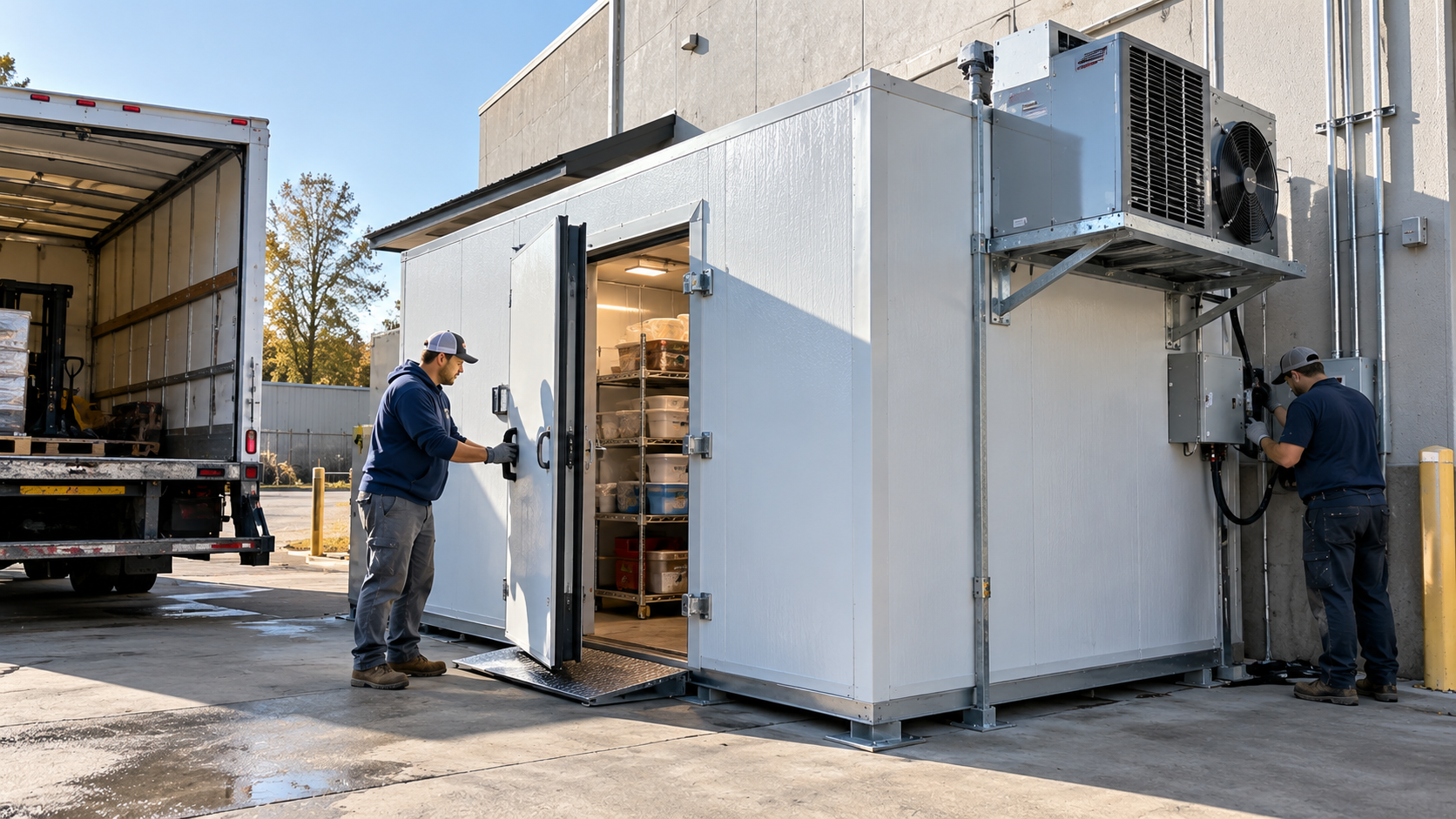
A mobile walk-in freezer bridges that gap. It is a refrigerated trailer parked beside your building. It holds product at temperature while the permanent unit is fixed or replaced.
This guide covers what rentals cost in Virginia, how to size a unit, and what to ask before you sign. Prices and terms come from the published rental page and agreement of VA Commercial Repair Solutions, our company. Use them as one real price point, not a market average.
When a mobile freezer rental makes sense
A refrigeration failure is the classic trigger. Walk-in repairs often need parts that are not on the truck. A rental keeps inventory cold while the part is ordered, shipped, and installed.
Planned work is the second reason. A remodel, a floor replacement, or a new walk-in freezer installation takes the old box offline for days. Renting turns that downtime into a scheduled project instead of a scramble.
Peak demand is the third. Weddings, school functions, corporate events, and holiday rushes can outgrow a permanent freezer. Short-term cold storage often costs far less than a second unit you would use twice a year.
Power loss is the fourth. Storms and electrical faults can strand product in a perfectly healthy freezer. A trailer needs its own power source, so settle that plan before the storm arrives.
A rental is a bridge, not a fix. Early diagnosis is cheaper, and refrigeration repair prevents food loss before a trailer is ever needed. Still, equipment fails on its own schedule, so know your options in advance.
Watch the food safety clock
Time and temperature decide what you can keep. Virginia Department of Health guidance tells households to discard perishables held above 40°F for two hours or more. USDA says frozen food should stay at or below 0°F.
Restaurants and caterers answer to the local health department. Call it early if product has warmed. Ask what documentation an inspector will expect, and start a temperature log the moment the problem appears.
What mobile freezer rentals cost in Virginia
Rental pricing is usually quoted by the week, with a lower rate for longer terms. The table below shows published rates for three trailer sizes. Confirm current rates when you call.
| Trailer size (nominal) | Weekly rate | 4-week rate | Effective weekly rate on 4-week term | Savings vs. four single weeks |
|---|---|---|---|---|
| 7' x 10' | $820 | $2,660 | $665 | About 19% |
| 7' x 12' | $890 | $2,880 | $720 | About 19% |
| 7' x 20' | $1,275 | $4,130 | $1,032.50 | About 19% |
The smallest unit works out to about $117 a day before delivery. That is the number to compare against the cost of spoiled inventory. A walk-in full of product can be worth far more than a week's rent.
The math favors longer terms only at four weeks. At three weeks, paying weekly is still cheaper on every size. A 7' x 10' unit costs $2,460 for three weekly invoices, versus $2,660 for the four-week rate.
Partial weeks count as full weeks under these terms. A unit held for one week and one day is billed for two. If your repair finishes on day eight, ask whether early pickup can be scheduled to avoid a second invoice.
Up-front payment and delivery
The published agreement calls for the first week's charge plus a one-week security deposit before delivery. The delivery charge is also due up front.
On the 7' x 12' unit, that points to roughly $1,780 plus delivery. Confirm the exact deposit when you book.
Delivery is priced at $2.00 per mile, port to port. Ask whether mileage is counted one way or round trip, and where the count starts.
Pickup is free under three conditions. Payments must be current and the unit must stay where it was parked. The provider also needs clear access around the clock.
Costs that sit outside the rental rate
The weekly rate rarely tells the whole story. Budget for these items before you commit:
- Electrician time. A licensed, insured electrician must install an independent circuit for the unit. Get that quote before delivery day, because it varies by building.
- Delivery mileage. A job at the far edge of the service area costs noticeably more than one near the shop. Ask for the total, not just the per-mile rate.
- Cleaning. The published terms charge $500 if the unit comes back dirty, not cleared out, or carrying odors. Wipe it down and remove all product before pickup.
- Late or failed payments. A $250 charge applies to non-payment or returned payments, plus the initial delivery fee. Keep the payment method on file current.
- Spoilage and lost business. The terms put food-loss risk on the renter. Check whether your business insurance covers spoilage before you need it.
How to size a mobile walk-in freezer
The listed sizes are nominal. They describe the outside of the trailer. Interior space is smaller because of wall thickness, shelving, and the cooling equipment.
Ask for interior length, width, and height. Ask how many pallets or shelf positions the unit holds. Then work through four steps.
- Count the product. Tally cases, pans, and loose items in the failed unit. Include anything at risk in nearby reach-ins.
- Measure the footprint. Stack height and shelf depth matter more than total cubic feet. A standard pallet is 48 by 40 inches, so plan your layout around it.
- Leave air space. Cold air must circulate around product. Packing a trailer wall to wall can create warm spots and slow recovery after the door opens.
- Plan for the peak. If a holiday week or event is coming, size for that week, not today.
If you are between two sizes, choose the larger one. The weekly gap between the 7' x 10' and the 7' x 12' is only $70. The jump to the 7' x 20' is $385 more than the 7' x 12'.
The footprints stay modest. At nominal dimensions, the three units cover 70, 84, and 140 square feet. VA Commercial's rental page says each trailer takes one standard parking space.
A starting point for common situations
Capacity depends on how you stack and shelve, so treat this table as a starting point. Your own inventory count should make the final call.
| Situation | Likely starting size | Why it fits |
|---|---|---|
| Small café or bar with one failed walk-in | 7' x 10' | Lowest weekly rate and the smallest footprint |
| Full-service restaurant with a walk-in down for repair | 7' x 12' | Extra room for a normal week of inventory for $70 more |
| Wedding venue, school kitchen, or multi-day event | 7' x 20' | Room for surge inventory and several product types |
| Remodel with the whole cold line offline | 7' x 20', or two units | Frozen and refrigerated product can be separated |
Frozen and refrigerated product need different temperatures. Ask whether you need a freezer, a refrigerator, or both. VA Commercial offers both mobile freezers and mobile refrigerators, so confirm which unit you are booking.
Rental versus the alternatives
A trailer is not the only way to protect product. It is worth comparing the other options before you book. Each one carries trade-offs that show up under time pressure.
Borrowed freezer space is the cheapest option on paper. It depends on a neighbor's capacity, and transport time counts against your food safety clock. Product also changes hands several times, which adds handling risk.
Dry ice is a common stopgap that buys hours, not days. It can raise carbon dioxide levels in enclosed spaces. That makes it a poor fit for a small walk-in that staff enter.
Third-party cold storage warehouses work for large volumes. They usually involve hauling, minimum quantities, and scheduling that may not match a sudden failure. A trailer on your own lot keeps product where your staff can reach it.
Power, placement, and site prep
Power is the step most renters underestimate. VA Commercial's units run on a 110V, 20-amp plug or single-phase 208-230V, 30-amp service. Each rental includes up to 50 feet of #10 cord.
The unit needs its own independent circuit within 40 feet of where it parks. The agreement calls for a licensed, insured electrician to install it. The circuit needs a separate ground and neutral, sized to the manufacturer's specifications.
The units are built to hold a set temperature in both hot and cold weather, per the rental page. Even so, plan for shade and clear airflow around the trailer.
Do not share the circuit with other equipment. A shared breaker that trips overnight can warm a full trailer by morning. Inverter generators are available when grid power is the problem, so ask about one if you face an outage.
Where to park it
Choose a level, firm surface. The renter is responsible for providing one under the agreement. Keep the trailer close enough to the building that staff can move product quickly.
Check access for the delivery vehicle before booking. Overhead lines, tight turns, and soft ground all cause delays. Landlords, shopping-center managers, and fire officials may have rules about trailers near buildings, so ask early.
Once the unit is parked, it stays put. The terms say the renter must not move or tamper with it. If you need it relocated, call the provider.
What to ask before you sign
A good rental company answers these questions without hesitation. Ask them on the first call, and get the answers in writing.
- What are the interior dimensions and holding temperature? Nominal size and usable space differ. Confirm the unit can hold 0°F if you are storing frozen product.
- How is billing structured? Ask about weekly versus four-week rates, and how partial weeks are handled. Under VA Commercial's terms, fees are not divisible.
- What is due before delivery? Expect the first week, a security deposit, and the delivery charge. Ask how the deposit is returned.
- How is delivery mileage calculated? Get the starting point and whether the count is one way or round trip. Ask for a total in writing.
- What power does the unit need? Confirm plug type, amp rating, cord length, and the maximum distance from the circuit. Hand the answers to your electrician.
- What happens if the rental unit fails? Read the failure clause. VA Commercial's published terms allow three regular business weekdays to repair or replace a failed unit. Ask any provider how it handles an overnight failure.
- Who carries spoilage risk? The renter does under these terms. Call your insurance agent before you book, not after a loss.
- What does return look like? The unit must come back clean, cleared out, and odor-free. Ask how to schedule pickup and who must be on site.
- How fast can it arrive? VA Commercial quotes delivery 24 to 48 hours after booking. Ask any provider for a firm window, not a range.
Plan your exit before you rent
A rental is only as short as your repair. Get a firm diagnosis and parts timeline from your commercial refrigeration repair provider before you book. That tells you whether you need one week or four.
Some repairs cannot be done at all. A failed compressor or a leak in an aluminum coil usually means replacement, not repair. If your technician points that way, price the replacement while the trailer is running.
Rental terms keep running until the unit is cancelled and picked up. VA Commercial's agreement requires cancellation by email, with "CANCELLATION OF BAILMENT" in the subject line. The provider then has 72 hours to remove the unit, and fees keep accruing in that window.
Move-in checklist: the first 24 hours
A few habits protect product after delivery. They also give you records if the health department asks questions.
Let the unit reach its set temperature before loading. Mobile units are built to hold temperature, not to pull down a warm load quickly. Move frozen product first, and keep the door closed between trips.
Label shelves so staff find items without searching. Track the temperature at set intervals, and write each reading down. Keep the log with your delivery paperwork.
Finally, tell your team who to call if the unit alarms or the power drops. A 2 a.m. problem needs a name and a number on the door.
Common mistakes to avoid
Waiting until product is warm. The two-hour and four-hour marks in food safety guidance run quickly. Book the rental when the failure is confirmed, not after the first discard.
Choosing the smallest size to save money. A $70 weekly difference is small next to a second delivery trip. If inventory overflows, you pay twice.
Skipping the electrician. A trailer without a ready circuit is an expensive empty box. Schedule the electrical work while you wait for delivery.
Ignoring the return condition. A cleaning fee of $500 is avoidable. Empty, wipe, and air out the unit before pickup.
Assuming the rental covers lost product. It does not under these terms. Confirm your own insurance first.
Frequently asked questions
How fast can a mobile freezer be delivered in Virginia?
VA Commercial quotes delivery 24 to 48 hours after booking. Availability changes with demand, so call early. Calls are answered around the clock.
How far does delivery reach?
The rental page says units are available throughout Virginia and within a 250-mile radius of the Fishersville base. It also says the fleet operates in Virginia, North Carolina, Pennsylvania, and Maryland. Delivery runs $2.00 per mile, port to port.
Do I need an electrician?
Yes. The agreement calls for a licensed, insured electrician to install an independent circuit. That circuit must sit within 40 feet of the parking spot.
What temperature do I need for frozen food?
USDA guidance says frozen food should stay at or below 0°F. Ask any rental company to confirm that the unit can hold that temperature. Verify it with your own thermometer on delivery day.
How long can I keep the unit?
The minimum rental is one week, billed weekly or monthly. The agreement states no fixed end date. The rental continues until you cancel it in writing.
Can I rent a unit just for an event?
Yes. The rental page lists weddings, corporate events, school functions, and holidays as common uses. Hosts use the extra cold storage for food, beer, and ice.
Conclusion: rent early, size up, and read the terms
A mobile walk-in freezer buys you time when equipment fails or demand spikes. In Virginia, a one-week rental of the smallest unit starts at $820 on the published rate sheet. The real cost depends on size, term, delivery distance, and the electrical work.
Size for your inventory plus air space, and favor the larger unit when in doubt. Settle power before delivery, read the failure and return clauses, and check your insurance. Those steps decide whether a rental saves your product or adds a second problem.
Need cold storage for a failed walk-in or an upcoming event? Call VA Commercial Repair Solutions at (540) 457-4822 or toll-free at (866) 729-2215. A live person answers day or night, with no voicemail. Ask about current availability, and get delivery scheduled before the product warms.

Opening a Restaurant in Virginia: Kitchen Design, Hood, Fire Suppression and Refrigeration Checklist