
Stay Frosty! Charlottesville's Best Commercial Refrigeration Installation Providers

Gregg Kell VACRS

Why Professional Commercial Refrigeration Installation Matters for Your Business

Commercial Refrigeration Installation Charlottesville services are essential for restaurants, grocery stores, and food service businesses that need reliable cooling systems to protect inventory and maintain health code compliance.

When your walk-in cooler breaks down, expensive products spoil and your kitchen operation grinds to a halt. Commercial refrigeration equipment accounts for up to 60% of a restaurant's total energy consumption , making professional installation crucial for both food safety and cost control.

The difference between a smooth installation and a costly disaster often comes down to proper sizing, code compliance, and expert commissioning. Poor installation is responsible for up to 40% of service calls , leading to unnecessary downtime and repair costs.

As Gregg Kell VACRS, I've spent years covering the commercial HVAC and refrigeration industry, focusing on how businesses can make informed decisions about Commercial Refrigeration Installation Charlottesville services. My experience writing for VA Commercial Repair Solutions has given me deep insights into what separates reliable local providers from the rest.

Top Commercial Refrigeration Installation Charlottesville Providers

When your walk-in cooler fails on a busy Friday night, you need more than just a contractor—you need a partner who understands the urgency. Finding the right installation team can save you thousands in spoiled inventory and lost revenue down the road.

The best Commercial Refrigeration Installation Charlottesville providers share some key traits: they answer their phones when you call (even at 2 AM), they know the difference between a reach-in merchandiser and a blast chiller, and they understand that downtime costs you money every minute.

What really separates the pros from the rest? They design systems that actually work for your business, not just whatever they have on the truck. Whether you're running a farm-to-table restaurant downtown or managing a grocery store in the surrounding counties, the right installer will take time to understand your specific needs. More info about Commercial Refrigeration Installation

VA Commercial Repair Solutions – 24/7 "No-Voicemail" Specialists

Here's something refreshing: a company that actually answers their phone. VA Commercial Repair Solutions built their reputation on a simple promise— no voicemail, ever . When your refrigeration system goes down, you get a real person who can help, not a recording asking you to leave a message.

Their approach to Commercial Refrigeration Installation Charlottesville focuses on fixing what you have before selling you something new. Can't repair your existing equipment? They'll pay you $50 and credit $500 toward a replacement system. That's confidence in their technical skills, not just sales talk.

The company serves Charlottesville, Harrisonburg, Waynesboro, Staunton, Lexington, and Fishersville with true 24/7/365 availability. Their installation packages include comprehensive preventative maintenance bundles worth $747, featuring Ranco/Sporlan controllers and two full years of scheduled maintenance.

As a SWaM certified business (Small, Women, and Minority-owned), they bring both technical excellence and community commitment to every project. Their technicians handle everything from walk-in coolers and ice machines to specialized equipment for local vineyards and microbreweries.

What really sets them apart is their high installation volume, which has earned them manufacturer-certified engineering support . This means every system gets properly designed and commissioned, not just thrown together and hoped for the best.

Specialty Walk-In & Display Case Installers

Charlottesville's food scene isn't cookie-cutter, so why should your refrigeration be? The city's diverse businesses need custom solutions that work with their unique spaces and requirements.

Custom walk-in boxes serve farm-to-table restaurants dealing with tight kitchen spaces and historic building constraints. Florist coolers require precise humidity control that keeps delicate arrangements fresh without freezing the petals. Quick-serve retrofits often demand creative engineering to maximize cooling efficiency in spaces that weren't designed for modern equipment.

The best specialty installers work closely with architects and designers to create systems that blend seamlessly with your business aesthetic. A vineyard tasting room has completely different needs than a downtown coffee shop or university dining facility.

Green Refrigeration Consultants

Environmental responsibility isn't just good PR anymore—it's good business. Forward-thinking Charlottesville businesses are finding that sustainable refrigeration solutions often pay for themselves through energy savings.

Natural refrigerants like CO2 and ammonia have minimal global warming potential compared to traditional synthetic options. KE2 sensors and IoT monitoring systems help track energy consumption and optimize performance automatically. Sustainability audits identify specific opportunities to reduce environmental impact while cutting operating costs by 20-30% annually.

These consultants understand that going green doesn't mean sacrificing performance. The newest eco-friendly systems often outperform older equipment while using significantly less energy.

How to Choose the Right Commercial Refrigeration System

Choosing the right refrigeration system isn't just about picking the biggest or cheapest option – it's about finding the perfect fit for your specific business needs. Think of it like buying a car: a food truck needs something completely different than a full-service restaurant.

Temperature range is your starting point. A florist displaying delicate roses needs precise 34-38°F control, while that popular gelato shop downtown requires rock-solid -5°F to 10°F temperatures to keep their artisan flavors at the perfect scooping consistency. Getting this wrong means spoiled inventory and unhappy customers.

Your product load tells the whole story of your business. Are you storing fresh produce that turns over daily, or frozen items that sit for weeks? Planning for future growth now saves expensive retrofits later – that small café might become a catering operation sooner than you think.

Floor space often makes the decision for you. Cramped downtown locations might need creative reach-in solutions, while suburban restaurants with generous back-of-house areas can accommodate efficient walk-in units. Ice demand varies wildly too – a seafood restaurant goes through mountains of ice compared to a sandwich shop.

Don't overlook energy rebates from local utilities. These incentives can make high-efficiency models surprisingly affordable, turning what seemed like an expensive upgrade into a smart financial move. More info about Walk-In Freezer and Refrigerator Case Design and Installation in Charlottesville VA

Understanding the science helps too. Scientific research on vapor-compression refrigeration reveals why proper system design makes such a difference in efficiency and reliability. It's fascinating stuff, even if you're not an engineer.

Sizing & Load Calculations

Here's where many Commercial Refrigeration Installation Charlottesville projects go wrong – improper sizing. It's like Goldilocks and the three bears, except the consequences are much more expensive than uncomfortable porridge.

Oversized systems short-cycle constantly, wasting energy and wearing out components faster. Undersized units struggle during busy periods, leading to temperature swings that spoil food and stress equipment. Getting it just right requires understanding your specific heat loads.

BTU load calculations consider everything that affects your system. Product load includes all that room-temperature food entering your cooler. Infiltration happens every time someone opens the door – and in busy kitchens, that's constantly. Transmission is heat sneaking through walls and insulation, while internal sources like lighting and fans add their own burden.

Don't forget about personnel – every person working in a walk-in cooler adds body heat to the equation. During prep rushes, this becomes significant.

Professional installers use specialized software that accounts for ambient heat from cooking equipment, customer traffic patterns, and your specific product turnover rates. This isn't guesswork – it's precise engineering that ensures your system performs perfectly from day one.

Equipment Types & Best Use-Cases

Walk-in coolers are the workhorses of commercial kitchens. They're perfect for high-volume operations needing bulk storage with easy staff access. Restaurants, cafeterias, and grocery stores rely on their generous capacity and convenient walk-through design.

Walk-in freezers serve businesses storing frozen products long-term. Ice cream shops depend on consistent sub-zero temperatures, while meal prep facilities need reliable frozen storage for their weekly batch cooking operations.

Reach-in merchandisers do double duty – displaying products attractively while maintaining proper temperatures. Convenience stores showcase drinks and snacks, delis display prepared foods, and bakeries keep pastries fresh while tempting customers.

Blast chillers are the unsung heroes of food safety. They rapidly cool hot foods to safe temperatures, essential for commercial kitchens following HACCP protocols. Without them, that big batch of soup could spend too long in the danger zone.

Ice machines range from compact undercounter units producing 100 pounds daily for small cafés to massive modular systems cranking out over 1,000 pounds for high-volume operations. Size matters, but so does ice quality and reliability.

Keg coolers maintain draft beer at optimal serving temperatures. With Charlottesville's thriving craft beer scene, restaurants and bars need systems that keep those local brews tasting exactly as the brewmaster intended.

Energy Efficiency & Sustainability Features

Modern refrigeration systems are incredibly sophisticated compared to older models. EC motors (electronically commutated) automatically adjust speed based on cooling demand, dramatically reducing energy consumption during slower periods.

LED lighting produces significantly less heat than traditional fluorescent fixtures, reducing the cooling load while lasting much longer. It's a win-win that pays for itself quickly.

Smart controllers constantly monitor system performance and make tiny adjustments for optimal efficiency. They're like having a dedicated technician watching your system 24/7, making smart decisions to save energy.

Low-GWP refrigerants (low global warming potential) minimize environmental impact while maintaining excellent cooling performance. They're becoming the standard as regulations tighten and businesses prioritize sustainability.

The best part? Energy-efficient systems often qualify for utility rebates that reduce upfront costs while providing long-term savings. It's like getting paid to do the right thing for your business and the environment.

Step-By-Step Commercial Refrigeration Installation Charlottesville Process

Getting a new refrigeration system installed doesn't have to be a headache. When you work with experienced professionals, the Commercial Refrigeration Installation Charlottesville process follows a proven roadmap that minimizes surprises and keeps your business running smoothly.

Everything starts with a thorough site survey. Your installation team will examine your electrical capacity, check plumbing access, measure the space carefully, and identify any structural challenges. This isn't just a quick look-around – it's a detailed assessment that prevents costly mistakes down the road.

Next comes the paperwork phase. Code compliance and permits might sound boring, but they're crucial for avoiding problems later. Your installer handles applications to Charlottesville authorities, ensuring everything meets local building codes and health department requirements.

The real work begins with electrical and plumbing rough-in. This behind-the-scenes preparation sets the foundation for everything else. Then comes box assembly for walk-in units, where precise measurements and proper insulation techniques make all the difference.

Refrigeration rack installation requires certified technicians who understand EPA regulations inside and out. The refrigerant charging process follows strict protocols – this isn't the time for shortcuts. Finally, system commissioning puts everything through its paces under real-world conditions.

Don't forget about staff training. The best installation in the world won't help if your team doesn't know how to operate the system properly. Good installers take time to walk your staff through proper procedures and answer questions.

Aspect DIY Install Professional Install
Upfront Cost Lower Higher
Downtime 3-5 days 1-2 days
Warranty Limited/None Full coverage
Code Compliance Risk of violations Guaranteed
Performance Variable Optimized
Long-term Reliability Questionable Proven

The numbers tell the story. While professional installation costs more upfront, you get faster completion, full warranty coverage, guaranteed compliance, and optimized performance . That's worth a lot when your business depends on reliable refrigeration. More info about Refrigeration Repair Service

Local Codes, Health & Safety Compliance

Charlottesville takes its building codes seriously, and for good reason. Your permit application needs detailed plans showing equipment specifications, electrical loads, and refrigerant quantities. Miss something important, and you're looking at delays and potential fines.

Health department clearance is especially critical for restaurants and grocery stores. Food safety isn't negotiable – one violation can shut you down until problems are fixed. Professional installers know exactly what inspectors look for and ensure everything meets requirements the first time.

EPA Section 608 certification is mandatory for anyone handling refrigerants. This isn't optional – it's federal law. Professional installers maintain current certifications and follow proper procedures for refrigerant recovery, recycling, and disposal.

Typical Timeline & Business Downtime

Small reach-in installations typically take 2-3 days from start to finish, including delivery, installation, and commissioning. It's usually pretty straightforward – not much disruption to your daily operations.

Walk-in systems are a bigger undertaking, usually requiring 5-7 days for complete installation. But smart installers use phased approaches to keep business disruption to a minimum. Nobody wants to shut down completely for a week.

Phased installation strategies are lifesavers for busy restaurants and stores. You might lose some refrigeration capacity temporarily, but you can keep serving customers. Some installers even arrange temporary refrigeration rentals during critical phases.

Preventing Common Installation Failures

Level floors might seem obvious, but you'd be surprised how often this gets overlooked. Uneven surfaces cause door seals to fail, letting warm air sneak in and driving up energy costs. A little extra attention during site prep saves headaches later.

Vapor barriers are another critical detail that separates amateur from professional work. Skip this step, and moisture infiltration will damage insulation and create ice buildup problems. Proper installation techniques ensure your system performs well for years.

Getting the correct superheat settings requires real expertise. Set them wrong, and you risk compressor damage or poor efficiency. Professional installers have the tools and knowledge to optimize these settings for your specific system.

Thorough leak testing catches problems before they become expensive failures. A small leak during installation becomes a big headache six months later when your system starts acting up. Good installers test everything multiple times before calling the job complete.

Maintenance & Sustainability: Keeping Your Investment Cool

Your Commercial Refrigeration Installation Charlottesville investment deserves protection. Think of maintenance like brushing your teeth – skip it, and you'll pay the price later. The good news? Proper care can extend your equipment's lifespan to 15+ years while keeping it running at peak efficiency.

Regular coil cleaning might seem like a small thing, but dirt and debris act like a thick winter coat on your condenser. When airflow gets restricted, your system works harder and uses more energy to achieve the same cooling. It's like trying to breathe through a stuffy nose – everything becomes more difficult.

Gasket checks prevent those sneaky air leaks that silently drain your energy budget. A worn door seal might look harmless, but it's letting expensive cold air escape while warm, humid air sneaks in. This creates a vicious cycle where your system runs constantly trying to maintain temperature.

Defrost calibration ensures your system removes ice buildup without wasting energy on unnecessary heating cycles. Too little defrost and ice blocks airflow. Too much and you're literally melting money. Professional technicians know how to find that sweet spot.

Modern remote monitoring systems act like a health tracker for your refrigeration equipment. They catch problems before they become emergencies, sending alerts when temperatures drift or energy consumption spikes unexpectedly.

Well-maintained systems deliver utility savings of 20-30% compared to neglected equipment. That's real money back in your pocket every month. 7 Tips for a Happy Commercial Refrigerator provides detailed guidance for keeping your investment running smoothly.

Service Contracts & Warranty Essentials

Service contracts take the guesswork out of maintenance costs. Instead of crossing your fingers and hoping nothing breaks, you get predictable monthly expenses and priority service response when issues arise.

Comprehensive agreements cover both parts and labor coverage , protecting you from surprise repair bills. Quality contractors typically offer maintenance starting around $149 for the first unit and $99 for additional units , including free diagnostics and priority scheduling.

The ROI on preventive maintenance agreements usually pays for itself through reduced emergency repairs and extended equipment life. It's like having insurance that actually prevents problems instead of just paying for them after they happen.

Response time guarantees ensure you won't be left waiting when refrigeration fails. Every hour of downtime costs money in spoiled inventory and lost sales, making rapid response worth its weight in gold.

Monitoring & Smart Controls

KE2 sensors and IoT monitoring systems transform your refrigeration from a "set it and forget it" appliance into a smart, responsive system. These sensors provide real-time performance data and send alert emails when something needs attention.

Energy dashboards help identify optimization opportunities you might never notice otherwise. Maybe your freezer is working harder during lunch rush, or perhaps one unit is consuming more power than it should. This data helps you make informed decisions about repairs, replacements, and operational improvements.

Smart controllers automatically adjust system operation based on actual conditions rather than fixed settings. They're like having a technician constantly fine-tuning your equipment for optimal performance, reducing energy consumption while maintaining perfect temperatures.

Frequently Asked Questions about Commercial Refrigeration Installation in Charlottesville

Let's be honest – when you're facing a refrigeration installation, you probably have a dozen questions swirling around in your head. Will this break the bank? How long will I be out of business? Am I going to end up in trouble with the health inspector?

These are the questions we hear most often from Charlottesville business owners, and they're all completely valid concerns. After all, your refrigeration system isn't just equipment – it's the heartbeat of your operation.

What does professional installation cost and what affects pricing?

Here's the thing about refrigeration installation costs: they're all over the map , and there's a good reason for that. A small reach-in cooler for your coffee shop might run you $3,000-$8,000 installed , while a full walk-in system for a restaurant could easily hit $15,000-$50,000 or more .

The price tag depends on several key factors that most people don't think about upfront. Equipment size and type is the obvious one, but site preparation requirements can really surprise you. Maybe your electrical panel needs upgrading, or the plumbing rough-in is more complex than expected.

Permit and inspection fees vary depending on your project scope, and if you want those energy-efficient features (which you should), expect to pay a bit more upfront. The good news? Many utility rebates can offset those costs, and most professional installers offer financing options that won't strain your cash flow.

Think of it this way: a quality installation is like buying good insurance. You pay more now to avoid headaches later.

How long will my business be without refrigeration during install?

Nobody wants to shut down their business, even for a day. The timeline really depends on what you're installing and how complicated your site is. Simple reach-in replacements often wrap up in just one day – you might even stay open with minimal disruption.

Complex walk-in installations are a different story, typically requiring 5-7 days from start to finish. But here's where working with experienced Commercial Refrigeration Installation Charlottesville professionals makes all the difference.

Smart installers minimize your downtime through detailed pre-planning and creative scheduling. They might offer phased installation approaches where they keep part of your system running while upgrading the rest. Some even provide temporary refrigeration rentals for critical situations.

Many contractors will work after-hours and weekends to accommodate your business schedule. Emergency situations get priority scheduling – some companies even offer same-day service when you're in a real bind.

The key is communication. A good installer will walk you through the timeline upfront and have backup plans ready.

How do I stay compliant with Charlottesville health and building codes?

This is where things can get really stressful if you try to go it alone. The compliance maze includes building codes, health department requirements, and EPA regulations – and getting it wrong can be expensive.

Professional installers handle all the permit applications and inspections , which takes a huge weight off your shoulders. They know exactly what Charlottesville inspectors are looking for and how to get approvals quickly.

Building code compliance covers the structural stuff – making sure your equipment is properly supported, electrical capacity is adequate, and ventilation meets requirements. Fire safety considerations are also part of this puzzle.

Health department requirements focus on food safety. Your system needs to maintain proper storage temperatures , provide easy sanitation and cleaning access , and meet HACCP compliance standards if you're running a commercial kitchen. Documentation and record-keeping are crucial here.

EPA regulations get technical fast. Refrigerant handling, leak detection, and disposal all have strict rules. Only certified technicians should handle this work – it's not worth the risk of hefty fines.

Working with licensed, insured contractors ensures all regulatory requirements are met and properly documented. You'll have the paperwork you need for inspections and peace of mind knowing everything was done right.

Compliance isn't just about avoiding fines – it's about protecting your customers, your employees, and your business reputation.

Conclusion

When it comes to Commercial Refrigeration Installation Charlottesville , the difference between a smooth operation and costly headaches often comes down to one crucial decision: choosing the right installation partner. Professional installation isn't just about getting your equipment running – it's about protecting your investment, your inventory, and your peace of mind.

The numbers tell the story clearly. Proper system sizing cuts energy costs by up to 30%, while expert installation reduces service calls by 40%. Full compliance with local codes and regulations keeps health inspectors happy and your business operating without interruption. Manufacturer warranty protection ensures you're covered when unexpected issues arise.

Most importantly, professional installation maximizes energy efficiency while extending equipment life well beyond what DIY approaches can achieve. The reduced long-term operating costs often pay for the installation investment within the first few years of operation.

Whether you're launching that farm-to-table restaurant you've dreamed about, expanding your successful catering business, or finally replacing that temperamental walk-in cooler that's been giving you gray hairs – the installation partner you choose shapes everything that follows. A quality installation means fewer 2 AM emergency calls, lower utility bills, and more time focusing on what you do best: serving customers.

Here's what makes VA Commercial Repair Solutions different from the rest: when you call, a real person answers – no voicemail, ever . Our repair-first approach means we'll try to save your existing equipment before recommending replacement. If we can't fix it, we'll pay you $50 and credit $500 toward your new system.

Our 24/7 availability across Charlottesville, Harrisonburg, Waynesboro, Staunton, Lexington, and Fishersville means help is always just a phone call away. Comprehensive service guarantees and preventative maintenance bundles ensure your refrigeration investment delivers maximum value and reliability for years to come.

Don't let refrigeration problems put your business on ice. Contact our live-answer team today for expert consultation and installation services that keep your operation running smoothly – because your success is too important to leave to chance.
By Chuck Weisman • September 26, 2026
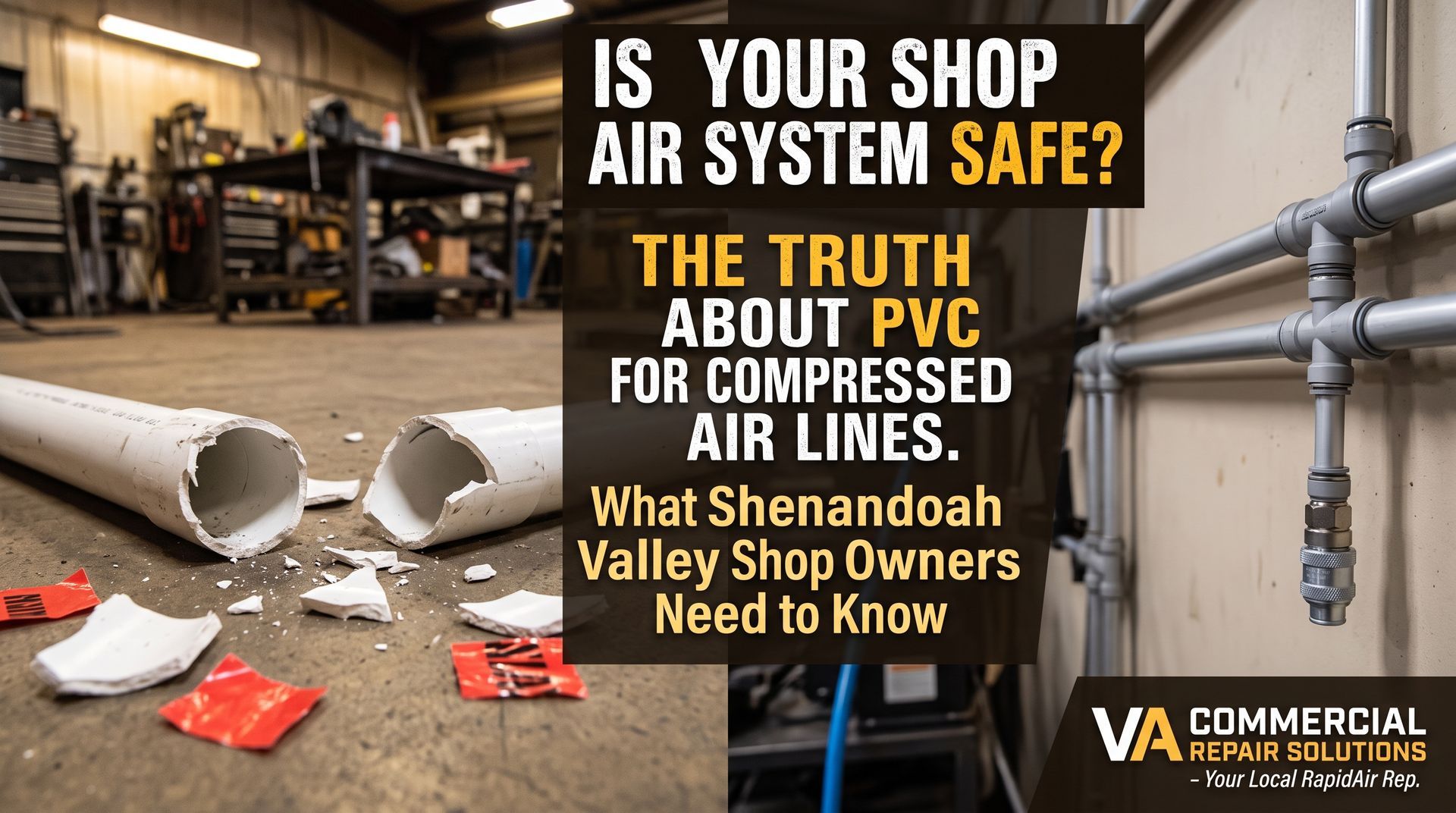
PVC can shatter under compressed air. Here is what the OSHA record says and how VA Commercial Repair Solutions replaces it with RapidAir piping.
By Chuck Weisman • September 26, 2026
PVC can shatter under compressed air. Here is what the OSHA record says and how VA Commercial Repair Solutions replaces it with RapidAir piping.
September 23, 2026
 A commercial building is a network of mechanical, electrical and refrigeration systems that all have to work together. When one part fails, the symptoms are not always obvious. A walk-in cooler that will not hold temperature might have a refrigerant leak, a failing compressor, a bad controller or an electrical issue feeding the unit. A restaurant exhaust fan that stops pulling air might be a motor problem, a belt issue, a make-up air imbalance or a wiring fault. That is why many businesses search for commercial mechanical contractors near me when they need more than a basic service call. A true commercial mechanical contractor can look across connected systems, diagnose the cause and coordinate the repair without forcing the owner or facility manager to call three separate vendors. For restaurants, breweries, food processing plants, schools, retail buildings and industrial facilities, that multi-trade capability can protect inventory, reduce downtime and help keep operations compliant. What is a commercial mechanical contractor? A commercial mechanical contractor installs, repairs and maintains the mechanical systems that keep a commercial facility operating. In practice, that often includes HVAC, refrigeration, boilers, chillers, ventilation, kitchen exhaust, gas piping, compressed air, equipment controls and related electrical work. The exact scope depends on licensing, training and the contractor’s business model. Some companies focus mainly on HVAC. Others, like VA Commercial Repair Solutions, work across commercial HVAC, restaurant refrigeration, electrical, boilers, chillers, range hoods, fans, ice makers and related facility systems. The difference matters because commercial buildings rarely fail in neat categories. If a rooftop unit trips a breaker, the problem may not be only electrical. If a kitchen line feels hot and smoky, the issue may involve the hood, exhaust fan, make-up air and fire suppression layout. A mechanical contractor with broader commercial experience can trace those overlaps faster. Commercial HVAC systems Commercial HVAC is one of the core areas mechanical contractors handle. This can include heating, air conditioning, ventilation, ductwork, controls and rooftop equipment. Common commercial HVAC work includes: Rooftop unit repair and replacement Split system and packaged unit service Heat pump and furnace repair PTAC and mini-split service for hotels, offices or specialty spaces Ductwork installation, balancing and repair Thermostat and control troubleshooting Preventive maintenance programs Refrigerant leak diagnosis and conversion support For a business, HVAC work is not just about comfort. Poor cooling can drive customers away, affect employee productivity and create unsafe indoor conditions for kitchens or production spaces. Poor ventilation can create odors, humidity issues and code concerns. If your current concern is air conditioning performance, this guide to commercial HVAC repair explains what businesses should look for in a qualified repair provider. Commercial refrigeration and cold storage Commercial refrigeration is a separate skill set from standard comfort cooling. It involves tighter temperature requirements, food safety risk and equipment that often runs around the clock. Mechanical contractors with refrigeration capability can handle walk-in coolers, walk-in freezers, reach-in coolers, prep tables, ice machines, chillers and specialty cold storage. In restaurants and food facilities, even a small temperature drift can become expensive if inventory is lost or health-code compliance is affected. A refrigeration service call may involve checking evaporator coils, condenser airflow, refrigerant charge, door gaskets, defrost timers, drain lines, fan motors, compressor operation and electrical controls. For cold storage and food processing facilities, refrigeration may also be tied to 3-phase power, alarms, backup systems and production schedules. This is one reason a commercial mechanical contractor is often a better fit than a residential HVAC provider. The stakes, equipment types and diagnostic process are different. Restaurant equipment, hoods and exhaust systems Restaurants, institutional kitchens and food-service operations need specialized mechanical support. A contractor working in these environments may handle cooking equipment, exhaust hoods, exhaust fans, make-up air, stainless fabrication, fire suppression coordination and refrigeration. Kitchen exhaust systems deserve special attention. Type 1 hoods are used over grease-producing equipment, while Type 2 hoods handle heat or steam. These systems need proper airflow, fire-safety design and ongoing maintenance. The NFPA 96 standard is one of the major references for ventilation control and fire protection in commercial cooking operations. A hood or exhaust problem can quickly affect an entire kitchen. Smoke, heat, grease vapor and negative air pressure make it hard to operate safely. Sometimes the issue is not the hood itself, but the fan, belts, bearings, make-up air fan, electrical feed or rooftop access. A mechanical contractor can inspect the complete system instead of treating each component in isolation. Boilers, chillers and hydronic systems Many commercial buildings use boilers, chillers or hydronic systems for heating, cooling or process loads. These systems are common in schools, industrial plants, larger commercial buildings, breweries and facilities with high heating or cooling demand. Commercial mechanical contractors may handle: Steam boiler and hot water boiler service Boiler pump and control troubleshooting Chiller repair and replacement Hydronic piping repairs Heat exchanger inspection Combustion and safety checks Preventive maintenance before peak heating or cooling season Boilers and chillers require disciplined diagnostics. A short cycling boiler, unstable chiller pressure or repeated lockout can point to controls, water flow, combustion, heat transfer or electrical issues. Guesswork is expensive, especially when the system supports production or a large occupied building. Commercial electrical work tied to mechanical systems Mechanical equipment depends on safe, reliable electrical infrastructure. Motors, compressors, controls, contactors, transformers, panels and disconnects all affect whether a system runs correctly. This is where the line between mechanical and electrical work becomes practical rather than theoretical. A walk-in freezer compressor may look like a refrigeration problem, but the root cause could be voltage imbalance. An exhaust fan may fail because of a worn motor, but also because of a starter, overload or wiring issue. A processing line may shut down because a breaker trips under load. A contractor licensed for both mechanical and electrical work can reduce the handoff problem. Instead of having one company say “call an electrician” and the electrician say “call the HVAC company,” the same team can evaluate the complete equipment circuit. For businesses comparing electrical support options, this overview of commercial electric repair service covers preventive maintenance, troubleshooting and licensing considerations.
September 23, 2026
 Commercial AC problems are not all equal. A slightly warm conference room is annoying; a failed rooftop unit over a dining room on a 92°F afternoon can cut sales, create staff safety concerns and strain refrigeration equipment that is already working hard. If you are searching for same day AC repair, the practical question is simple: will waiting until tomorrow put people, inventory, equipment, revenue or compliance at risk? If the answer is yes, treat it as a same-day service call. If the system is still controlling temperature and the issue is stable, scheduled service may be the smarter choice. This guide is written for business owners, facility managers, restaurant operators and property managers in Virginia who need to decide whether an AC problem can wait. The simple rule: call the same day when waiting changes the outcome Same-day AC repair is not only for a total shutdown. It is for any cooling issue where delay is likely to make the problem more expensive or disruptive. Commercial HVAC systems serve larger spaces, longer operating hours and more demanding loads than residential systems. A problem that looks small at 9 a.m. can turn into a business interruption by the lunch rush or late afternoon. Use this quick triage table before deciding whether to call now or schedule later.
September 17, 2026
 Commercial buildings depend on systems that rarely operate in isolation. A rooftop HVAC unit affects airflow and comfort, but it may also tie into electrical panels, ductwork, controls, gas piping and building ventilation. A walk-in cooler is refrigeration equipment, but a temperature failure can involve compressors, relays, evaporator fans, drain lines, door gaskets or the electrical circuit feeding the unit. That is where a mechanical contractor becomes different from a single-trade repair vendor. For facility managers, restaurant owners, food processing operators and property managers, knowing when to call a mechanical contractor can prevent downtime, protect inventory and reduce the risk of unsafe repairs. If you are searching for a “mechanical contractor near me,” the real question is not only who is closest. It is whether the contractor can diagnose the full building system, not just the first failed part they notice. What a mechanical contractor does for commercial buildings A mechanical contractor works on the systems that move air, water, refrigerant, heat, gas and sometimes compressed air through a commercial facility. In practical terms, that can include commercial HVAC, refrigeration, boilers, chillers, kitchen exhaust, ductwork, gas piping, air compressors and related controls. In a small office, the issue might be a rooftop unit that is short cycling. In a restaurant, it might be a make-up air problem causing the kitchen hood to pull poorly. In a dairy, cold storage facility or brewery, it might be a refrigeration and electrical issue happening at the same time. The value of a mechanical contractor is that they look at the system as a connected whole. That matters because the visible symptom is often not the root cause. A warm dining room may come from a failing compressor, but it may also come from a clogged coil, low airflow, a thermostat issue, undersized ductwork or an exhaust imbalance. A freezer that cannot hold temperature may not need a new box. It may need a defrost repair, door adjustment, refrigerant diagnosis or electrical troubleshooting. For commercial facilities, this broader view is especially important because downtime usually costs more than the service call. Lost product, unhappy tenants, failed inspections, canceled service and emergency replacement decisions can all stem from waiting too long or calling the wrong type of contractor. Call a mechanical contractor immediately for safety-critical symptoms Some building system problems should be treated as urgent, even if the equipment has not fully failed yet. Safety comes first. If there is an active fire, suspected carbon monoxide exposure, a strong gas odor or an immediate electrical hazard, evacuate as appropriate and call emergency services or the utility before calling a repair contractor. Once the immediate life-safety concern is addressed, a qualified mechanical contractor should inspect the affected system before it is returned to service. That is especially true for boilers, gas-fired equipment, commercial kitchens, electrical panels and mechanical rooms. Gas, combustion or boiler warning signs Call right away if you notice unusual burner behavior, rollout, soot, repeated boiler lockouts, pressure problems, banging pipes, water around boiler equipment or a combustion smell. Commercial boilers and gas-fired appliances should not be treated as trial-and-error repairs. A cracked boiler combustion chamber, failed heat exchanger or unsafe combustion condition can put occupants and staff at risk. A contractor should be able to test and show the evidence, not simply say that replacement is needed. For commercial buildings, documentation matters because owners, managers and inspectors may need a clear record of what failed and why. Electrical symptoms tied to mechanical equipment Repeated breaker trips, hot disconnects, burning odors, buzzing panels, motor failures or flickering lights near equipment should not be ignored. Mechanical systems often fail because of electrical conditions, and electrical systems can be damaged by failing motors, compressors or controls. The National Electrical Code , published by NFPA as NFPA 70, is the core safety standard for electrical installation in the United States. In a commercial setting, repair work needs to respect both equipment requirements and code requirements. If a freezer, RTU, exhaust fan or air compressor keeps tripping a breaker, replacing the breaker without diagnosing the load can create a larger hazard. For issues involving panels, circuits, motors or power distribution, a contractor with commercial mechanical and electrical capability can reduce finger-pointing between separate vendors. VA Commercial Repair Solutions covers this kind of overlap through its commercial electric repair service , which is useful when the symptom sits between the equipment and the electrical infrastructure. Refrigeration temperature failures Restaurants, grocery operations, cafeterias, breweries, wineries, dairies and cold storage facilities should call quickly when refrigeration equipment cannot hold temperature. Waiting overnight can turn a repair into a product-loss event. The FDA Food Code uses 41 degrees Fahrenheit or below as the cold-holding standard for many time and temperature control foods. Facility teams should follow their own food safety procedures and local health department requirements, but a walk-in cooler trending upward should be treated as urgent before it becomes a failed inspection or discarded inventory. A mechanical contractor should inspect the entire refrigeration system, including evaporator fans, condenser condition, drain problems, defrost controls, door seals, refrigerant level and electrical components. Refrigerant work should be handled by properly certified technicians. The EPA’s Section 608 technician certification requirements apply to technicians who maintain, service, repair or dispose of equipment that could release refrigerants. Kitchen exhaust and make-up air problems Commercial kitchens rely on balanced ventilation. If the hood is not capturing smoke, grease vapor or heat properly, the issue may involve exhaust fans, make-up air, belts, ductwork, controls or the design of the hood system itself. Warning signs include smoke spilling into the kitchen, doors becoming hard to open, pilot lights being affected by airflow, hot kitchen conditions, grease odors outside the hood area or fan noise that changes suddenly. These are not just comfort problems. They can affect fire safety, employee working conditions and health inspection readiness. A mechanical contractor experienced with commercial kitchens can evaluate the hood, exhaust fan, make-up air and related electrical controls together instead of treating each component separately. Call before performance problems become shutdowns Not every mechanical issue looks like an emergency at first. Many failures begin as small changes in performance. The system still runs, but it takes longer to recover, makes more noise, uses more energy or needs frequent resets. For commercial HVAC systems, early signs include hot and cold zones, weak airflow, short cycling, recurring thermostat complaints, unusual odors, rising utility use or water around equipment. If the issue is specifically with air conditioning, this guide to commercial HVAC repair covers how maintenance and timely diagnosis can prevent larger failures. For refrigeration, pay attention to frost buildup, longer compressor run times, water on the floor, fluctuating case temperatures, noisy fan motors and repeated ice maker faults. For boilers and chillers, warning signs include slow recovery, alarms, leaks, pump noise, water treatment concerns or pressure changes. The best time to call is often when the pattern changes, not when the unit stops. Facility staff usually know what normal looks and sounds like. If something feels different for two or three shifts in a row, document it and have it checked.
September 17, 2026
If you are trying to budget for a commercial HVAC visit in Virginia, the simplest answer is this: a standard business-hours diagnostic service call commonly falls somewhere around $150 to $350 before repair work, parts, refrigerant or specialty equipment . Emergency, weekend or after-hours calls can cost more, especially when the technician is responding to a no-cooling, no-heat or food-safety emergency. That number is only the starting point. A commercial HVAC service call cost can change quickly based on the type of equipment, rooftop access, the amount of troubleshooting required, travel time, electrical complexity and whether the repair can be completed on the first visit. VA Commercial Repair Solutions does not publish a flat online service-call menu, because commercial systems vary widely. The company does, however, offer no service call fee when repair work is performed and free installation quotes.  For business owners and facility managers, that distinction matters: the lowest diagnostic fee is not always the lowest total cost if the contractor cannot diagnose the system correctly or has to come back with parts that should have been stocked. Typical commercial HVAC service call cost in Virginia Use the ranges below as planning estimates, not a guaranteed quote. A small office heat pump in Waynesboro, a rooftop unit serving a restaurant in Charlottesville and a larger packaged unit on a school or production facility in Harrisonburg can all require different time, access and parts.
September 11, 2026
 A tripped breaker at 6 p.m. on a Friday doesn't wait for Monday. Neither does a burning smell from a panel, or a kitchen circuit that goes dark mid-shift. Electrical failures don't check your business hours first. Electrical malfunction is a real cause of building fires, not just an inconvenience. It accounts for 7.2% of nonresidential building fires nationally, per the U.S. Fire Administration . Not every electrician who advertises "24/7 service" staffs it the same way. Some route after-hours calls to an answering service. Others keep a live dispatcher and a truck ready to move. That gap matters more than it looks. A message left with an answering service might not reach a technician until morning. For a walk-in freezer losing power, that delay can cost far more than the repair itself. Coverage area matters just as much. A contractor with a fast response time three counties away is still a slow response time for you. This guide covers five Virginia companies built around commercial and industrial emergency electrical repair. Each was evaluated on response model, service area, and the kind of facility their work actually fits. None of them serve every corner of the state. Matching location to need matters just as much as picking a familiar name. This list is narrower than general electrical contracting, too. For panel-upgrade costs, breaker troubleshooting, and 3-phase power basics, our commercial electrical guide and cost estimates covers that broader ground. Which Virginia Companies Handle Emergency Electrical Repair? VA Commercial Repair Solutions answers every call with a live manager, 24/7, across the Shenandoah Valley. NIMPRO Electrical brings ISNetworld-certified commercial and industrial service to the Richmond area. Chewning + Wilmer has served Central Virginia's industrial base since 1924. White Electric Company covers Hampton Roads from Virginia Beach, and CMI Companies rounds out the list from Northern Virginia.
September 11, 2026
For a restaurant, food loss rarely starts with a cooler that is completely dead. It often starts with a few degrees of drift, a door gasket that no longer seals, a fan motor that slows down during dinner rush or a walk-in freezer that takes too long to recover after deliveries. That is why restaurant refrigeration repair is not just an equipment expense. It is inventory protection, food safety support and revenue protection for the kitchen. When a reach-in, walk-in cooler, prep table, freezer or ice machine fails, the cost is rarely limited to parts and labor. The bigger loss may be the product you have to throw away, the menu items you cannot sell and the staff time spent scrambling to move food. Why refrigeration problems create food loss so quickly Restaurants hold high-value ingredients in equipment that runs all day, every day. Meat, seafood, dairy, sauces, produce, dough, desserts and prepared foods depend on consistent temperature control. If one box warms up during a busy shift, a kitchen can lose hundreds or thousands of dollars in product before anyone sees a puddle on the floor or hears an alarm. The FDA Food Code uses 41°F or below as the cold-holding standard for time and temperature control for safety foods. The USDA Food Safety and Inspection Service also advises that perishable foods held above 40°F for more than 2 hours may need to be discarded in emergency situations.  Restaurants should follow their food safety plan, local health department guidance and internal temperature logs, but the practical lesson is simple: time and temperature determine whether product can be saved. Food loss usually comes from four connected problems: Inventory spoilage from unsafe product temperatures Service disruption when menu items cannot be prepared or sold Labor waste from moving, checking, labeling and discarding food Reputation risk if quality drops or a food safety issue occurs A cooler that is “almost holding” can still create a loss. If the air temperature reads 39°F near the thermostat but pans of chicken, cream sauce or sliced tomatoes are sitting at 45°F after a rush, the equipment is no longer doing its job for the kitchen. What restaurant refrigeration repair actually protects Good repair work does more than restart a unit. A restaurant refrigeration technician looks for the reason the equipment lost control in the first place, then restores the system’s ability to hold temperature under real operating conditions. That may mean cleaning a blocked condenser, replacing a failing evaporator fan motor, correcting a defrost issue, repairing a refrigerant leak, replacing a control sensor or fixing an electrical fault. In some cases, the repair is not inside the refrigeration circuit at all. A loose connection, bad contactor, tripped breaker or overloaded circuit can shut down a system that looks like a refrigeration failure to the kitchen team. This matters because quick fixes can hide the real threat. Adding refrigerant without finding a leak, resetting a breaker without identifying the cause or chipping ice off an evaporator coil without solving the airflow problem may get the box cold for a few hours. It may also lead to the same failure during the next service period, when the walk-in is full and the kitchen has no time to react. If your team is trying to reduce recurring losses, it helps to pair timely repairs with documented maintenance. VA Commercial Repair Solutions covers practical steps in its guide to maintaining commercial refrigeration equipment , including coil care, gasket checks, leak detection and temperature monitoring. Common refrigeration failures that put inventory at risk Not every failure looks urgent at first. Some of the most expensive food loss events begin with small symptoms that were easy to overlook.
September 11, 2026
 A cracked glycol line at 2 a.m. doesn't wait for business hours. Neither does a stuck bottling line the morning before a release. Microbreweries and vineyards run equipment most general repair shops have never opened up. Calling the wrong contractor costs more than a delayed service call. A tech who doesn't understand food-grade sanitation can contaminate a batch. One who doesn't understand glycol cooling can leave a fermentation room warm for days. Virginia's craft beverage sector has grown into one worth protecting. The state counts 344 craft breweries, good for 11th nationally, per the Brewers Association . Virginia Wine tracks more than 300 wineries on top of that. That's a lot of fermentation tanks, draft lines, and vineyard tractors. Each one eventually needs a technician who has actually worked on it before. None of these are one-trade problems, either. A brewery's chiller failure could be electrical, mechanical, or purely refrigeration. Figuring out which one it is first often wastes the hours that matter most. A vineyard's tractor breakdown is a completely different discipline from a bottling line jam. Both show up under the same "equipment repair" search, but almost nobody fixes both well. This guide covers five Virginia companies that repair microbrewery and vineyard equipment. Each was evaluated on trade scope, certifications, and service area. We also weighed how directly their daily work touches this niche, not just how they market themselves. Who Repairs Brewery and Vineyard Equipment in Virginia? VA Commercial Repair Solutions covers the Shenandoah Valley with certified draft technicians and in-house steel fabrication. Valley Restaurant Repair works the same corridor as a broader multi-trade shop. Welding Processes & Mechanical brings statewide boiler, chiller, and steel fabrication coverage. AC Beverage specializes narrowly in draft beer systems across the DC-Maryland-Virginia region. Amos Equipment Repair keeps Goochland County vineyards' tractors running. Together, the five cover a wider slice of the niche than any single company could alone. Pick based on which piece of equipment is actually down, not which name sounds most familiar.
September 4, 2026
 A power outage does more than turn off the lights for a Virginia business. Production lines stop, refrigerated inventory spoils, and servers can lose data in seconds. Berkeley Lab's interruption-cost research puts the toll on U.S. businesses in the billions every year. Virginia's commercial generator market splits between two kinds of installers. Some are electrical contractors who added generators to a broader service list. Others are dedicated power specialists who sell, size, and service backup systems full time. The average U.S. electricity customer already loses about 341 minutes a year to non-momentary outages, per EIA reliability data . For a commercial kitchen or a cold storage facility, that adds up to real, repeated risk. This guide covers the eight best commercial generator installation companies in Virginia. Each was evaluated on service area, brand relationships, installation depth, and commercial support. Virginia's Top Commercial Generator Installers, At a Glance VA Commercial Repair Solutions engineers and installs standby power for commercial and industrial clients across central Virginia. The Power Connection is a Harrisonburg-based generator specialist serving the Shenandoah Valley and beyond. Carter Power Systems, the Caterpillar dealer's power division, handles industrial-scale generators statewide. Elite Power & Energy Corporation is a veteran-owned, multi-brand dealer serving Northern Virginia, Maryland, and DC. RECORE specializes in Energy-as-a-Service standby power for Hampton Roads businesses. Prestige Electric handles Generac-certified generator installation across the Tidewater region. SS Electrical Solutions installs and maintains Generac systems for Richmond-area homes and businesses. McGrady-Lambert Electric brings generator installation to Roanoke's commercial and industrial facilities.