
Office AC SOS – How to Find Reliable Commercial Air Conditioning Servicing

Gregg Kell VACRS

Why Commercial Air Conditioning Servicing is Critical for Your Business

Commercial air conditioning servicing is the planned maintenance and repair of business HVAC systems to ensure reliable cooling, optimal performance, and extended equipment life. Here's what you need to know:

Key Commercial AC Services:

  • Preventative maintenance - Regular inspections and tune-ups (quarterly to annually)
  • Emergency repairs - 24/7 response for system failures
  • System diagnostics - Identifying issues before they cause downtime
  • Component replacement - Filters, coils, refrigerant, and parts
  • Performance optimization - Energy efficiency improvements

Common Service Triggers:

  • Strange noises (rattles, rumbles, roars)
  • Musty or electrical odors
  • Inconsistent cooling or warm air
  • High utility bills
  • Water leaks or pooling

When your office AC fails during peak business hours, employee productivity plummets and customer comfort suffers. Commercial HVAC systems can last about 20 years with proper routine maintenance , but neglecting service can lead to costly breakdowns at the worst possible times.

The stakes are high. A failing AC system doesn't just create discomfort - it can disrupt operations, damage inventory, and hurt your bottom line. Smart business owners know that proactive commercial air conditioning servicing is an investment, not an expense.

I'm Gregg Kell VACRS, and I've spent years helping Central Virginia businesses steer commercial air conditioning servicing challenges and avoid costly downtime. Through my work with VA Commercial Repair Solutions, I've seen how the right maintenance approach can save businesses thousands while keeping operations running smoothly.

Infographic on benefits of regular commercial AC servicing, listing energy savings, fewer repairs, and better air quality.

Why Your Business Can't Afford to Ignore AC Maintenance

Picture this: it’s the hottest afternoon of the year, your lobby is full of clients, and the AC sputters out. Within minutes, productivity drops, tempers rise, and customers head for the door. Situations like this are almost always preventable with routine commercial air conditioning servicing .

Regular service protects four critical areas:

  1. Energy efficiency – Dirt on coils or fans can slash capacity by 30%, forcing the system to run longer and spike utility bills.
  2. Equipment lifespan – A well-maintained system lasts 15-20 years; neglected units often fail in 10-12.
  3. Indoor air quality – Clean coils and drains stop mold, bacteria, and "sick-building" complaints.
  4. Business continuity – Fewer breakdowns mean employees stay focused and customers stay comfortable.


(For an overview of national best practices, see the U.S. Department of Energy’s guide to commercial HVAC systems .)


The Importance of Regular Commercial Air Conditioning Servicing

Consistent maintenance isn’t a cost—it's cash back to your bottom line:

  • 15–30% lower energy bills thanks to clean filters and calibrated controls.
  • Up to 50% fewer emergency calls because small issues are caught early.
  • 5–8 extra years of equipment life, delaying a major capital expense.

The Value of a Preventative Maintenance Plan

A structured plan from VA Commercial Repair Solutions turns surprise breakdowns into scheduled, budget-friendly visits.

  • Priority service during heat waves
  • Discounted repairs and parts
  • Predictable costs spread over the year
  • Peace of mind —focus on business, not HVAC

Most clients save 20–40% on total HVAC spend versus a "run-to-fail" strategy. Explore our options here: HVAC Maintenance Plans.

Warning Signs & Service Frequency: When to Call for Help

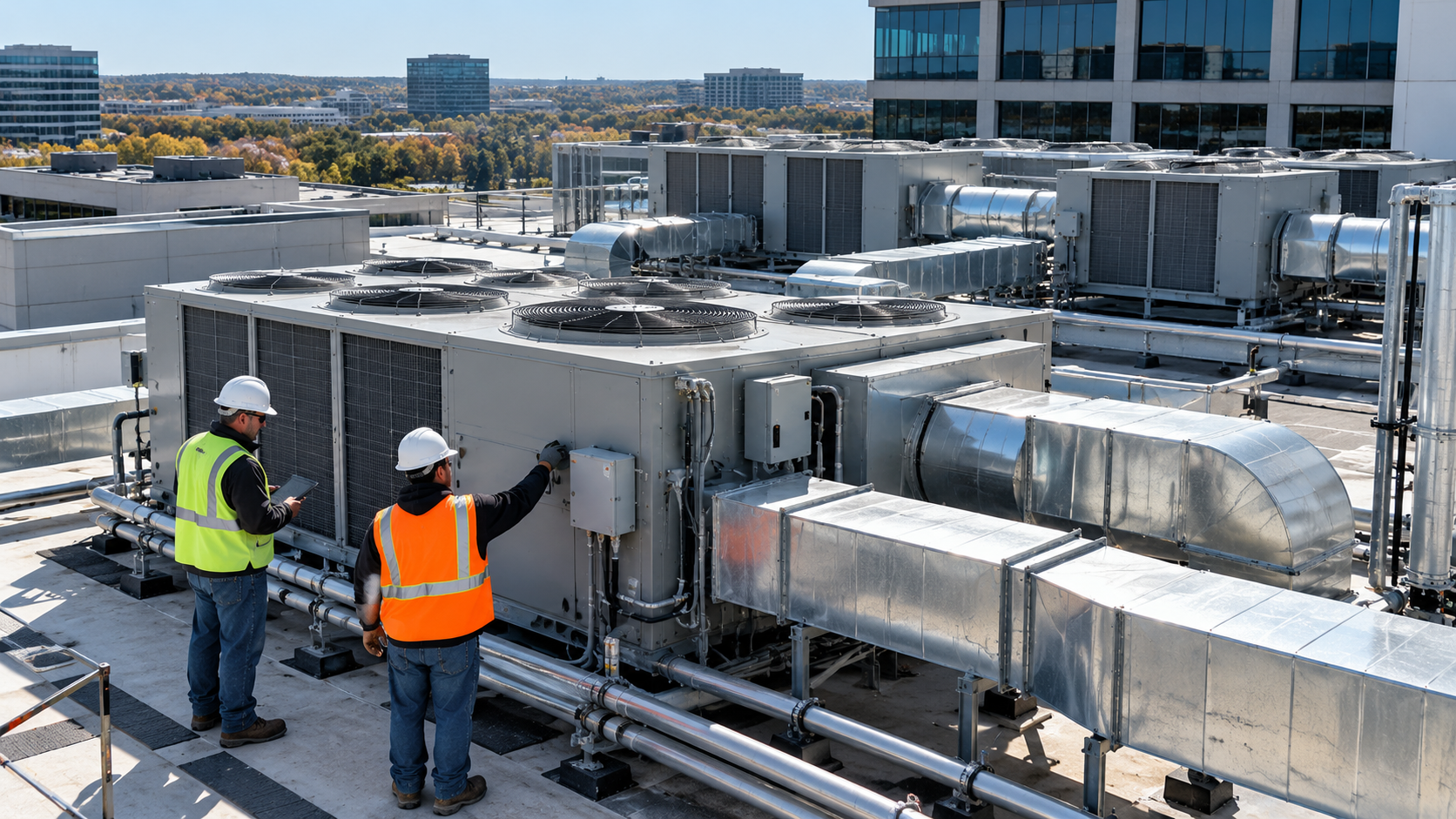
Technician in yellow hard hat inspects an outdoor HVAC unit with a tablet.

Your commercial AC system is constantly communicating with you - the trick is learning to listen. Most businesses miss these early warning signs and end up dealing with expensive emergency repairs instead of simple maintenance fixes.

Strange noises are your system's way of asking for help. When you hear rattles , it's usually loose components or debris that got into the system. Rumbles often mean your compressor is struggling or there's a motor issue brewing. Roars typically point to airflow problems or fan troubles. Don't ignore these sounds - they're much cheaper to fix now than later.

Unusual smells demand immediate attention. That musty odor means mold or mildew has taken up residence in your system, and it's about to spread throughout your entire building. Electrical smells are even more serious - they suggest wiring problems or overheating components that could become fire hazards.

Inconsistent cooling throughout your building is another red flag. When some areas feel like saunas while others are freezing, your system is working overtime and wasting energy. This usually points to ductwork issues, failing thermostats, or refrigerant problems.

High utility bills without any changes to your operations are a clear sign something's wrong. Your AC system is your building's biggest energy user, so when it starts struggling, your electric bill will show it first.

System leaks and poor airflow round out the major warning signs. Water pooling around your unit or weak airflow from vents both indicate problems that will only get worse if ignored.

For detailed guidance on identifying these issues, check out our comprehensive guide on How To Tell If Your HVAC System Needs Repair.

Telltale Signs Your Commercial AC Needs Service

Beyond the obvious warning signs, there are subtle indicators that often precede major system failures. Frequent cycling - when your AC turns on and off repeatedly without completing full cooling cycles - usually means problems with thermostats, refrigerant levels, or system sizing.

Water pooling around your AC unit suggests condensate drain problems or refrigerant leaks. These overflowing drains and drip trays can cause serious damage to ceilings, walls, and floors if you don't address them quickly.

Increased humidity levels in your building, even when the AC is running, indicate that your system isn't properly removing moisture from the air. This creates perfect conditions for mold growth and makes everyone uncomfortable.

Warm air coming from vents is obviously a problem, but it can have multiple causes. Low refrigerant levels, dirty coils, or compressor failure can all result in poor cooling performance. The key is getting professional diagnosis quickly to prevent further damage.

If you're experiencing any of these issues, don't wait for them to get worse. Contact us for prompt Commercial HVAC Repair services.

How Often Should Commercial AC Systems Be Serviced?

The frequency of commercial air conditioning servicing depends on your specific situation, but most systems benefit from quarterly to semi-annual professional maintenance. It's not a one-size-fits-all answer.

High-demand environments like restaurants, data centers, or manufacturing facilities need monthly attention because their systems work much harder than typical office buildings. The increased stress and air quality demands require more frequent care.

Critical temperature control applications - server rooms, laboratories, or medical facilities - should receive quarterly servicing at minimum. The cost of downtime in these environments far exceeds the investment in frequent maintenance.

System age plays a huge role in determining service frequency. Newer systems (0-5 years) typically need annual or semi-annual service, while older systems (10+ years) benefit from quarterly attention to catch age-related issues before they cause failures.

Usage patterns also influence service needs. Systems that run continuously or experience heavy seasonal loads require more frequent attention than those with moderate, consistent usage. We typically recommend checking air conditioning systems in spring and heating systems in fall, with additional visits based on your specific operational demands.

For businesses in Central Virginia, we provide comprehensive AC Maintenance services custom to your specific needs and schedule.

What to Expect from Professional Commercial Air Conditioning Servicing

Technician cleaning an HVAC coil with a spray bottle and brush inside an indoor unit

A proper service visit is more than a filter swap—it’s a full physical for your HVAC system.

  1. Comprehensive inspection – Technicians examine coils, motors, wiring, and safety controls.
  2. Deep cleaning – Specialized chemicals remove biological growth that garden hoses can’t touch.
  3. Safety & performance checks – Refrigerant pressures, airflow, thermostat calibration, and electrical integrity are verified.
  4. Action report – You receive clear findings, photos, and prioritized recommendations.

Details on our process: Commercial Air Conditioning Maintenance.

A Typical Commercial AC Service Checklist

  • Replace or clean air filters
  • Clean evaporator & condenser coils
  • Clear condensate drains
  • Test thermostats & controls
  • Inspect ductwork for leaks
  • Lubricate moving parts
  • Verify refrigerant charge & check for leaks
  • Tighten electrical connections
  • Test safety switches
  • Provide a written report

DIY Checks vs. Professional Servicing

Your staff can change filters and keep outdoor units debris-free. Everything involving refrigerant, electricity, or rooftop safety belongs to licensed pros—both for OSHA compliance and to keep warranties valid. Learn how to choose the right help: Find A Commercial AC Repair Expert In VA.

Types of Commercial Systems We Service

Rooftop Units (RTUs), Split Systems, Commercial Chillers, Ductless Mini-Splits, PTACs, and Make-Up Air Units—all maintained by technicians who understand Central Virginia’s climate demands.

Choosing Your Commercial HVAC Partner

Two men talking in an office hallway, one in a navy shirt and cap, the other in a dark suit and glasses.

Finding the right commercial air conditioning servicing partner isn't just about getting your AC fixed - it's about finding a team that understands your business can't afford to be uncomfortable. The wrong choice leads to repeated service calls, surprise costs, and that sinking feeling when your system fails during the busiest day of the year.

Licensing should be your starting point. Any contractor working on commercial systems in Virginia needs proper HVAC licenses. Don't assume - ask to see their credentials. Insurance protects everyone involved. If something goes wrong during a service call, you want to know both you and the contractor are covered.

Certifications tell you a lot about a company's commitment to quality. NATE certification isn't just a fancy acronym - it means technicians have passed rigorous testing and stay current with evolving HVAC technology. When your business depends on reliable climate control, this expertise matters.

Local experience makes a huge difference in commercial HVAC service. Contractors who understand Central Virginia's climate patterns, building codes, and common system challenges can diagnose problems faster and provide more effective solutions. They also know how to steer local suppliers and understand the unique needs of businesses in our area.

Customer reviews provide real insight into what working with a company actually feels like. Look for patterns in feedback about response times, problem-solving ability, and overall professionalism. Don't hesitate to ask for references from businesses similar to yours.

Repair guarantees show a company stands behind their work. When contractors offer comprehensive warranties on both parts and labor, they're confident in their ability to fix problems correctly the first time. This protection gives you peace of mind and demonstrates the company's commitment to quality.

You can learn more about our professional approach and company values through our LinkedIn company page.

Key Qualities of a Reliable HVAC Company

NATE-certified technicians represent the gold standard in commercial HVAC service. These professionals have demonstrated their knowledge through comprehensive testing and maintain their skills through ongoing education. When your business depends on consistent climate control, you want technicians who truly understand the complexities of commercial systems.

24/7 emergency service isn't just a nice-to-have feature - it's essential for businesses that can't afford downtime. Equipment failures happen at the worst possible times, and having access to immediate response can prevent a minor issue from becoming a major crisis. At VA Commercial Repair Solutions, we understand this urgency, which is why our calls are always answered live, never by voicemail.

Transparent pricing eliminates those unpleasant surprises that can wreck your budget. Reliable companies provide clear estimates upfront, explain their pricing structure in plain English, and avoid hidden fees. They should be able to discuss costs honestly and provide detailed explanations of why certain work is needed.

Strong local reputation develops over years of consistent, quality service. Companies with long-standing positive relationships in the community have earned that trust through reliable performance and genuine concern for their customers' success.

Repair-first philosophy can save your business thousands of dollars. Rather than pushing expensive replacements, ethical contractors focus on cost-effective repairs when they make sense. This approach demonstrates integrity and shows they genuinely care about your business's financial well-being, not just their own profit margins.

Fully-stocked service vehicles enable technicians to complete most repairs during the first visit. This reduces your downtime and eliminates the frustration of multiple service calls for the same problem. When your AC is down, you want it fixed quickly and completely.

Commercial air conditioning servicing infographic with 40% fewer callbacks, 60% reduced downtime, 35% customer satisfaction, $3,000 savings

Questions to Ask a Potential Commercial Air Conditioning Servicing Provider

Before committing to any commercial air conditioning servicing provider, ask these essential questions to ensure they can truly meet your business's needs:

Service area coverage matters more than you might think. Ask: "Do you provide service throughout our region, including after-hours emergency calls?" Make sure they can respond quickly to your location, whether you're in Charlottesville, Harrisonburg, Waynesboro, Staunton, Lexington, or Fishersville. Distance affects response time, and response time affects your business.

Response time commitments help you plan for potential downtime. Ask: "What's your typical response time for emergency calls, and do you guarantee it?" Understanding their response capabilities helps you prepare contingency plans and set realistic expectations.

Experience with your system type can make the difference between a quick fix and a drawn-out diagnostic process. Ask: "How much experience do you have with our specific AC system brand and model?" Specialized knowledge means faster diagnosis, more effective repairs, and fewer return visits.

Maintenance plan details vary significantly between companies. Ask: "What's included in your maintenance plans, and how often do you recommend service for our type of business?" Compare different plans carefully to find the best value for your specific needs and usage patterns.

Warranty on repairs protects your investment and indicates confidence in workmanship. Ask: "What warranty do you provide on parts and labor, and what exactly does it cover?" Strong warranties show the company stands behind their work and provides protection if something goes wrong.

Parts availability directly affects how quickly your system gets back online. Ask: "Do you stock common parts for our system type, or how quickly can you obtain needed components?" Quick parts availability reduces downtime during repairs and prevents extended business disruption.

These questions help you evaluate whether a contractor can meet your specific needs and expectations. Don't hesitate to ask for clarification on any points that aren't completely clear - a good contractor will appreciate your thoroughness.

For more information about our services and to discuss your specific needs, visit our Contact VA Commercial Repair Solutions page.

Frequently Asked Questions about Commercial AC Servicing

How long do commercial HVAC systems last?

With routine servicing, most units reach 15–20 years. Skip maintenance and life expectancy can drop below 10. Installation quality, run-time hours, and environment (kitchen vs. office) all influence longevity.

What causes a commercial AC to stop cooling effectively?

Dirty filters, low refrigerant, fouled coils, or a failing compressor are the usual suspects. A quick diagnostic visit pinpoints the cause before it snowballs. Need help now? Air Conditioning Repair.

Is it better to repair or replace an aging unit?

General rule: if the system is under 10 years old and repair costs <50% of replacement, fix it. Over 15 years old, inefficient, and needing frequent or costly repairs? Replacement makes financial sense. We’ll always price a repair first—then show you the numbers so you can decide. More details: AC Replacement.

Conclusion

Commercial air conditioning servicing isn't just about fixing things when they break - it's about protecting your business investment and ensuring your operations run smoothly year-round. The smart business owners we work with in Central Virginia understand that proactive maintenance saves money, prevents headaches, and keeps their teams productive even during the hottest summer days.

When your AC system is properly maintained, you're not just avoiding costly emergency repairs. You're reducing energy bills, extending equipment life, and creating a comfortable environment where employees can focus on what they do best. The businesses that thrive in our region's challenging climate are those that treat HVAC maintenance as a strategic investment, not an afterthought.

Choosing a reliable partner for your commercial air conditioning servicing needs makes all the difference between smooth operations and stressful breakdowns. You need a company that understands the urgency when your system fails, provides honest recommendations, and stands behind their work with real guarantees.

At VA Commercial Repair Solutions, we've built our reputation on being the partner Central Virginia businesses can count on. When you call us, you'll always reach a real person - no voicemail, ever . Our repair-first approach means we'll explore every cost-effective option before suggesting replacement, saving you thousands when possible. And our comprehensive service guarantees give you confidence that we'll make things right.

We're proud to serve businesses throughout Charlottesville , Harrisonburg , Waynesboro , Staunton , Lexington , Fishersville , and surrounding areas. Whether you're dealing with an emergency breakdown, need routine maintenance, or want to set up a preventative maintenance plan, we're here to keep your business comfortable and operational.

Don't wait until your AC fails during the next heat wave - and trust us, it always seems to happen at the worst possible moment. Take control of your commercial climate comfort today by partnering with professionals who understand that your business simply can't afford downtime.

Ready to experience the difference that reliable, professional commercial air conditioning servicing can make for your business? Explore our comprehensive HVAC services and find how we can help keep your business running smoothly year-round.
July 28, 2026
 Commercial refrigeration failure is one of the costliest equipment problems a food-service business can face. A walk-in cooler that stops working overnight can mean thousands of dollars in spoiled inventory by morning. A broken ice machine brings service to a halt faster than almost any other single failure. The problem is that most HVAC contractors don't actually service commercial refrigeration. Walk-in coolers, ice machines, and commercial chillers require different certifications, training, and tools than standard commercial AC. Call an HVAC company for a refrigeration problem and you often get someone learning your equipment on your dime. This guide identifies the four best commercial refrigeration and ice maker repair companies in Virginia. We evaluated each on refrigeration-specific experience, equipment coverage, certifications, geographic reach, and how they serve commercial operators in practice. Virginia's Top 4 Commercial Refrigeration Companies at a Glance VA Commercial Repair Solutions is the dedicated specialist for the Shenandoah Valley and central Virginia. They cover refrigeration, ice makers, walk-in coolers, and kitchen equipment under one Class A license. Elite Service & Enterprises serves Hampton Roads with a commercial-only cross-trade model that covers refrigeration, HVAC, and electrical in-house. Oasis Heating, A/C & Refrigeration covers Northern Virginia's light commercial refrigeration needs alongside their core HVAC practice. Reliance Repairs focuses on commercial ice machine and refrigeration repair across Northern Virginia and the Washington DC area.
July 28, 2026
An HVAC system rarely fails without warning. Most breakdowns follow a pattern of declining performance — reduced airflow, inconsistent temperatures, unusual sounds — that diagnosis catches early. Knowing how to read those signals lets you triage problems faster and hand off the right information to a technician. This guide walks through the steps of commercial HVAC diagnosis. Some checks you can perform yourself. Others require a licensed technician with specialized tools and EPA certification. We'll be clear about which is which throughout. Commercial HVAC diagnosis matters because misdiagnosis is expensive. A technician who swaps parts without isolating the root cause delivers a short-term fix. It often leads to repeat failure within weeks. According to the U.S. Department of Energy , a well-maintained commercial HVAC system can be 15–40% more efficient than a neglected one. Systematic diagnosis is how you protect that efficiency — and your budget. What Effective HVAC Diagnosis Actually Means Good diagnosis is not guessing. It's eliminating causes methodically until you identify the actual failure point. The best technicians work through a logical sequence. Check the control system before the hardware. Check simple hardware before complex hardware. Rule out maintenance issues before ordering parts. That same sequence is what this guide follows. Work through the steps in order. Don't skip ahead to the refrigerant circuit if you haven't checked the thermostat. Many expensive service calls trace back to a dead battery or a tripped breaker. Step 1: Start with the Control System Most HVAC "failures" aren't mechanical at all. They're control system issues — a wrong thermostat setting, the wrong operating mode, dead batteries, or a tripped circuit breaker. These cause a significant share of unnecessary service calls across the industry. Start at the thermostat. Verify it's set to the right mode (cooling, not heating). Confirm the setpoint is lower than the current room temperature. Confirm the fan is set to Auto, not On. If it's a battery-powered thermostat, swap the batteries before anything else. Then go to the electrical panel. Look for a tripped breaker on the circuit feeding the HVAC system. Reset it once. If it trips again, stop. A recurring trip signals an overload, short circuit, or ground fault — not a simple reset situation. Also check the disconnect switch near the outdoor condenser unit; these are frequently left in the "off" position after maintenance. Step 2: Inspect the Air Filters A dirty air filter is the most common preventable cause of commercial HVAC inefficiency. ENERGY STAR estimates that clogged filters make HVAC systems work harder, driving up energy costs and accelerating component wear. In commercial kitchens, restaurants, and manufacturing environments, filters clog far faster than the manufacturer's default schedule assumes. Check your filters monthly. Remove the filter and hold it up to a light source. If you can't see light through it, it needs replacing. Also check whether the filter has collapsed or pulled away from its frame. A compromised filter allows debris to bypass it and land directly on the evaporator coil. For commercial systems running multiple zones, check every filter, not just the accessible ones. A single clogged filter in a multi-zone system can restrict enough airflow to trigger alarms across the whole building. Step 3: Check the Outdoor Condenser Unit The outdoor condenser is where your system expels heat from the building. If it can't reject heat effectively, the whole system suffers — regardless of how well everything else functions. Clearance: The condenser unit needs at least 24 inches of unobstructed space on all sides. Vegetation, stored equipment, or debris against the unit restricts airflow and forces head pressure up. High head pressure strains the compressor and reduces cooling capacity. Coil condition: Look at the coil face for bent fins, debris embedded between the fins, or a visible dirt coating on the surface. A heavily fouled condenser coil can meaningfully reduce system efficiency. Coil cleaning requires professional tools and should never be attempted with a pressure washer — the fins are fragile aluminum and bend easily. Fan operation: With the system running, confirm the condenser fan is spinning. A failed fan motor causes the system to overheat and trip the compressor's thermal overload protection. The unit will appear to run but produce no cooling. Disconnect box: Inspect the condenser disconnect box for burn marks or discoloration around the terminals. Do not open or touch the internal components unless you are a licensed electrician. Step 4: Listen and Smell for Warning Signs Your HVAC system communicates through sound and odor. Unusual outputs from a running system are diagnostic data, not background noise. Grinding or squealing: Points to a failing bearing — typically in the blower motor or the condenser fan motor. Bearings wear predictably over time. Acting on a bearing symptom early is far cheaper than replacing a seized motor after it fails. Banging or rattling: Suggests loose components in the blower assembly, a bent fan blade, or a refrigerant line vibrating against sheet metal. If the banging is loud, turn the system off. Loose parts can cause secondary damage to adjacent components. Burning smell: A burning electrical odor means a wire, motor winding, or capacitor is overheating. Shut the system off immediately and call a technician. Running a system with an active electrical fault can cause a fire. Musty or mildew odor from vents: This typically indicates mold or biofilm growth in the drain pan or on the evaporator coil surface. According to the EPA , mold in HVAC systems can degrade indoor air quality and trigger health complaints in building occupants. Musty odors from vents should not be ignored. Step 5: Check for Refrigerant and Evaporator Issues The refrigerant circuit is the core of any cooling system. Problems here produce specific, recognizable symptoms that distinguish them from other failure types. Warm air from vents: If the system is running but blowing warm or room-temperature air, suspect a refrigerant issue, a failed compressor, or a severely fouled evaporator coil. Ice forming on refrigerant lines or the evaporator: Ice on the suction line (the larger insulated line running between indoor and outdoor units) usually means low refrigerant charge or severely restricted airflow. Turn the system off and let it thaw fully before restarting. Do not chip or pry ice from coils — you will damage the fins. Hissing or bubbling near refrigerant lines: Can indicate a leak point where refrigerant is escaping. EPA Section 608 regulations require that refrigerant handling — leak repair, evacuation, and recharge — be performed by a technician holding EPA Section 608 certification. This is not a DIY repair under any circumstances. If you suspect a refrigerant issue, shut the system off and call a licensed commercial HVAC technician. They'll locate the leak with an electronic detector, repair it at the source, and evacuate the system. Then they recharge it with the correct refrigerant type and quantity. Step 6: Inspect the Indoor Air Handler The air handler circulates conditioned air through your ductwork. Problems here affect airflow volume and temperature consistency across every zone the system serves. Drain pan: Check for standing water. A clogged condensate drain line is one of the most frequent service issues for commercial systems in Virginia's humid climate. Standing water in the drain pan grows mold quickly and eventually triggers a float switch that shuts the system off — or overflows onto equipment and finished ceilings. Blower wheel: If you can safely access the blower compartment, inspect the blower wheel for debris accumulation. A clogged blower wheel loses significant airflow efficiency and puts mechanical strain on the motor. Heavy buildup is a sign of a filter that was missed or bypassed. Evaporator coil: Look for visible dirt accumulation or ice. Coil cleaning requires specific tools and chemicals — it's a technician task. Attempting to clean an evaporator coil yourself with household cleaners can damage the fins and void equipment warranties. Step 7: Evaluate Ductwork and Airflow Distribution Duct problems can mimic equipment failures convincingly. A disconnected section or stuck damper can make the system look like it's failing when the central equipment is fine. Walk the facility and compare temperatures zone by zone. If some rooms are significantly warmer or cooler than others while the system runs, suspect ductwork before assuming equipment failure. Check visible ductwork for disconnected joints, tears or holes in flexible duct, and crushed or kinked sections. Also verify damper positions. Manually operated dampers are sometimes left closed after maintenance visits or seasonal adjustments. ENERGY STAR research indicates that duct leaks in commercial buildings can waste large portions of conditioned air. Often, that lost air never reaches the occupied space. Resealing duct connections is a cost-effective repair with a measurable impact on energy costs and comfort. Step 8: Know When to Stop and Call a Professional Some HVAC checks are safe to perform without trade experience or special tools. These include replacing filters, clearing condenser zones, resetting breakers, checking thermostat settings, and noting sounds. Most diagnostic steps beyond that require a licensed technician. Call a commercial HVAC contractor immediately when any of the following apply: A reset circuit breaker trips again without running the system You hear grinding, loud banging, or burning sounds from any component You smell burning from anywhere in the system The system runs but produces no cooling or heating You suspect a refrigerant issue (warm air, icing on lines, hissing) Standing water is visible in the drain pan or dripping from the unit The compressor cycles on and off in rapid succession (short cycling) Any electrical component shows burn marks, discoloration, or visible damage Attempting DIY repairs on refrigerant circuits, electrical panels, or compressors voids equipment warranties. Refrigerant handling without EPA Section 608 certification violates federal regulations and carries civil penalties. When an HVAC System Can't Be Repaired Not every HVAC failure is repairable. Some conditions require equipment replacement regardless of the technician's skill or the repair budget available. VA Commercial Repair Solutions — with 17+ years in central Virginia — identifies four failure types that can't be repaired: A failed compressor that tests open (ohms to infinity) or shorted to ground. The compressor is the heart of the refrigerant circuit. There is no field repair. A refrigerant leak in an aluminum evaporator coil. Copper coils can be brazed and repaired; aluminum coils cannot. A leaking aluminum coil means coil replacement. A failed heat exchanger made of cast iron. Steel heat exchangers can be welded and repaired; cast iron cannot. A cracked boiler combustion chamber. This is a code violation as well as a mechanical failure — replacement is mandatory. A good contractor shows you the evidence — meter readings, inspection results — not just asserts that replacement is needed. If a contractor recommends replacement without showing you why, ask to see the data. What to Tell Your Technician Before They Arrive The more precise information you provide, the faster the diagnosis. Before calling a commercial HVAC contractor, document these data points: Operating symptoms: What is the system doing, and what is it failing to do? Is it running but not cooling? Running briefly and shutting off? Not starting at all? When it started: Did the problem appear suddenly, or has performance been declining over days or weeks? Sudden failures often indicate electrical or mechanical events. Gradual decline points to maintenance issues — dirty coils, low refrigerant charge, failing capacitors. Any recent changes: Was the system serviced recently? Were filters changed? Was any construction or renovation work done near the equipment? Error codes or indicator lights: Modern commercial HVAC controls display fault codes when the system trips. Write down any codes showing on the thermostat or control board before the technician arrives. Fault codes narrow the diagnosis significantly. System age and service history: How old is the equipment? When was it last serviced? Has it needed repair before, and for what? Common Questions About HVAC System Diagnosis How do I know if my problem is electrical or mechanical? Electrical failures often appear as complete non-starts, tripped breakers, burn marks near components, or a burning smell. Mechanical failures produce sounds — grinding, squealing, banging — or visible damage like a bent fan blade. That said, the two often compound each other. A seized mechanical component puts electrical load on the motor winding, causing both failure types simultaneously. How long does a commercial HVAC diagnosis take? A qualified commercial technician can typically complete an initial diagnosis in one to two hours for standard equipment. Complex failures — refrigerant issues, building automation faults, multi-zone duct problems — may need a return visit with specialty equipment. Can I diagnose my commercial HVAC system myself? The steps in this guide cover what's safe to check without a license or specialized tools. Filter inspection, thermostat checks, condenser clearance, and sound/odor identification are all within reach. Anything involving refrigerant circuits, electrical panel access, or compressor testing requires a licensed technician. What is the most common cause of commercial AC failure in Virginia's climate? In Virginia's humid summers, four causes dominate. Dirty air filters create coil icing and compressor strain. Dirty condenser coils cut heat rejection capacity. Refrigerant leaks from worn fittings or coil corrosion are also common. So are failed capacitors or contactors — electrical parts that wear faster in Virginia heat. Regular preventive maintenance catches all four before they become failures. When does repair make more sense than replacement? If repair costs under 50% of replacement on a system less than 10 years old, repair wins. A system over 10 years old, with repeated repairs, or on a phased-out refrigerant usually calls for replacement. A trustworthy contractor will give you both numbers and let you decide. What does short cycling mean, and why is it a problem? Short cycling means the compressor starts and stops rapidly — typically less than two minutes per cycle. It indicates refrigerant issues, electrical faults, an oversized system, or a failing compressor. Short cycling causes extreme wear on the compressor and dramatically shortens equipment life. It should be diagnosed promptly. Conclusion: Diagnosis First, Repair Second Effective HVAC repair starts with effective diagnosis. A technician who replaces components without isolating the root cause delivers a short-term fix that often leads to repeat failure. Working through each system layer — control, filters, outdoor unit, sounds, refrigerant, air handler, ductwork — finds the real problem. For commercial facilities in Virginia, the stakes are high. Downtime costs money, failed health inspections cost permits, and equipment damage from a misdiagnosed repair compounds the original problem. Systematic diagnosis reduces all three risks. VA Commercial Repair Solutions completes 85% of calls in a single visit — the best first-visit rate in central Virginia. Schedule a service call today — Class A licensed, live phone 24/7. Can't fix it? They pay you for the trip.
July 28, 2026
A commercial AC failure during a Virginia summer isn't an inconvenience. It's a revenue crisis. Restaurant kitchens hit dangerous temperatures. Hotels lose bookings. Server rooms face equipment damage within hours. Most HVAC contractors you'll find online serve homeowners. Commercial systems run under heavier continuous loads and require a different licensing tier. Choosing a residential contractor for a commercial problem wastes time and often makes things worse. This guide covers the five best commercial AC and HVAC repair companies in Virginia. We evaluated each on service depth, contractor credentials, geographic coverage, and what they actually deliver for commercial operators. Virginia's Top 5 Commercial HVAC Companies at a Glance VA Commercial Repair Solutions covers the Shenandoah Valley and central Virginia with 24/7 live-person answering and a repair-before-replacement guarantee. Southern Air is Virginia's largest MEP contractor — 100% employee-owned since 1946 with 10 locations across three states.  James River Air has led Richmond commercial HVAC since 1967 with 150 technicians and 80+ service trucks. Elite Service & Enterprises is Hampton Roads' commercial-only specialist, covering HVAC, refrigeration, and electrical under a single Class A license. Oasis Heating, A/C & Refrigeration rounds out the list as Northern Virginia's combined HVAC and commercial refrigeration option since 1998.
rooftop ladder lawsuit
By Chuck Weisman July 7, 2026
A missing or unsafe rooftop ladder can cost far more than the ladder itself. See the real risks, real numbers, and a real court case.
Rooftop safety access ladders
By VA Commercial HVAC July 7, 2026
Rooftop access ladders keep workers safe and buildings up to code. Learn why they matter and how VA Commercial Repair Solutions installs them right.
Commercial AC Maintenance Services in Staunton VA
By Chuck Weisman May 24, 2026
Learn what comprehensive commercial AC maintenance in Staunton, VA typically includes, from inspections and cleaning to system testing and tune-ups.
Person analyzing data on multiple glowing monitors in a dark office
By Chuck Weisman May 20, 2026
Facing an HVAC emergency in Virginia? Discover the best platforms for emergency commercial HVAC repair in VA, plus what to ask before you hire anyone.
Technician providing Preventive Maintenance Services for Commercial HVAC Systems in Virginia
By Chuck Weisman May 20, 2026
Preventive maintenance services for Commercial HVAC systems in VA help businesses reduce downtime, improve energy efficiency, and extend equipment lifespan.
Two workers in hard hats stand on a rooftop with HVAC units and a city skyline behind them.
By Chuck Weisman May 20, 2026
Discover the best commercial HVAC services with our 2026 guide. Explore top HVAC companies in the USA, & get expert insights on HVAC installation & maintenance.
Signs Your Commercial AC Needs Maintenance Staunton VA
By Chuck Weisman May 13, 2026
Learn the warning signs your commercial AC system needs maintenance in Staunton, VA, including poor airflow, uneven cooling & higher energy costs.